Eight students will be presenting the summer work at the Ocean Sciences Meeting in March 2022!
Students Research Publications: Picocyanobacteria and deep-ocean fluorescent dissolved organic matter share similar optical properties
Year:
2017Authors:
Zhao, Z., M. Gonsior, J. Luek, S. Timko, H. Ianiri*, N. Hertkorn, P. Schmitt-Kopplin, X. Fang, Q. Zeng, N. Jiao and F. ChenSource:
Nature Communications 8, 15284 doi:10.1038/ncomms15284
Abstract:
Marine chromophoric dissolved organic matter (CDOM) and its related fluorescent components (FDOM), which are widely distributed but highly photobleached in the surface ocean, are critical in regulating light attenuation in the ocean. However, the origins of marine FDOM are still under investigation. Here we show that cultured picocyanobacteria, Synechococcus and Prochlorococcus, release FDOM that closely match the typical fluorescent signals found in oceanic environments. Picocyanobacterial FDOM also shows comparable apparent fluorescent quantum yields and undergoes similar photo-degradation behaviour when compared with deep-ocean FDOM, further strengthening the similarity between them. Ultrahigh-resolution mass spectrometry (MS) and nuclear magnetic resonance spectroscopy reveal abundant nitrogen-containing compounds in Synechococcus DOM, which may originate from degradation products of the fluorescent phycobilin pigments. Given the importance of picocyanobacteria in the global carbon cycle, our results indicate that picocyanobacteria are likely to be important sources of marine autochthonous FDOM, which may accumulate in the deep ocean.
Mentors:
Michael Gonsior, Ph.D.Students:
Hope Ianiri, Northeastern UniversityRECENT REU FELLOWS
-
 University: Florida International UniversityClass Year: 2024
 -
 University: University of Georgia AthensClass Year: 2015
 -
 University: Gustavus Adolphus CollegeClass Year: 2024
 -
 University: Pitzer CollegeClass Year: 2024
 -
 University: Eckerd CollegeClass Year: 2024
 -
 University: The College of WoosterClass Year: 2024
 -
 University: Haverford CollegeClass Year: 2024
 -
 University: Whitman CollegeClass Year: 2024
 -
 University: Washington CollegeClass Year: 2024
 -
 University: Panola CollegeClass Year: 2024
 -
 University: University of Puerto Rico HumacaoClass Year: 2024
 -
 University: University of Wisconsin-MadisonClass Year: 2024
 -
 University: University of ConnecticutClass Year: 2024
 -
 University: University of MichiganClass Year: 2024
REU NEWS
-
-
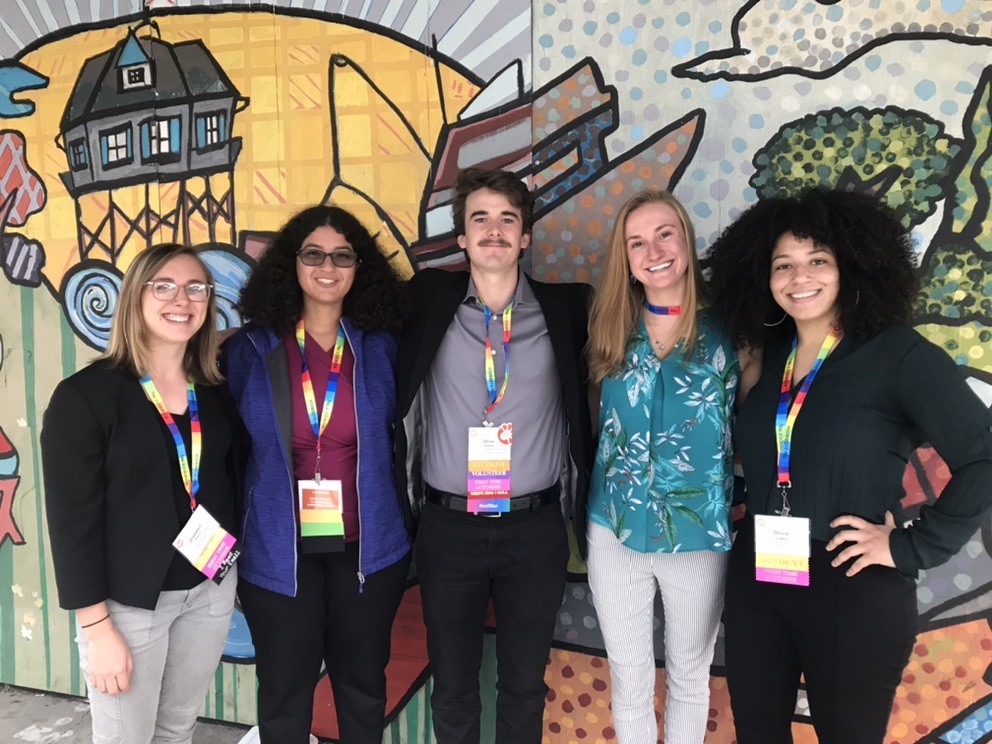
2019 REUs presented at the CERF Conference in Mobile, AL -
Olivia Saliger won a student presentation awards for talk at the 2019 Coastal Estuarine Research Federation Meeting. Her REU mentor was Judy O'Neil.
-
Congratulations to 2015 REU Alison Aceves for being selected as an honorable mention in the 2015 NSF Graduate Research Fellowship Program competition.
-
In February 2016, seven REUs from the 2015 cohort presented their research findings at the Ocean Sciences Meeting in New Orleans, Louisiana.
-
Congratulations to 2015 REU Hope Ianiri on receiving the NSF Graduate Research Fellowship (2016)!
-
Jeanette Davis, Ph.D. (REU '06) published a children's book, Science is Everywhere.
-
Like us on Facebook!