Knauss legislative fellowships in Congress help build careers — and they're fun and educational. See our video and fact sheet for details.
Sea Grant Community College Research Internship
Applications are closed for this position. Please check back for updates on the next application cycle.
The Community College Research Internship gives students the opportunity to conduct marine research on the Chesapeake Bay. During this eight-week program, each student works with a mentor on an individual research project. It’s a unique opportunity to develop your research skills and interests by working with outstanding science mentors studying America’s largest estuary.
Each research intern will receive a $700/week stipend. Additionally, housing is available if needed.
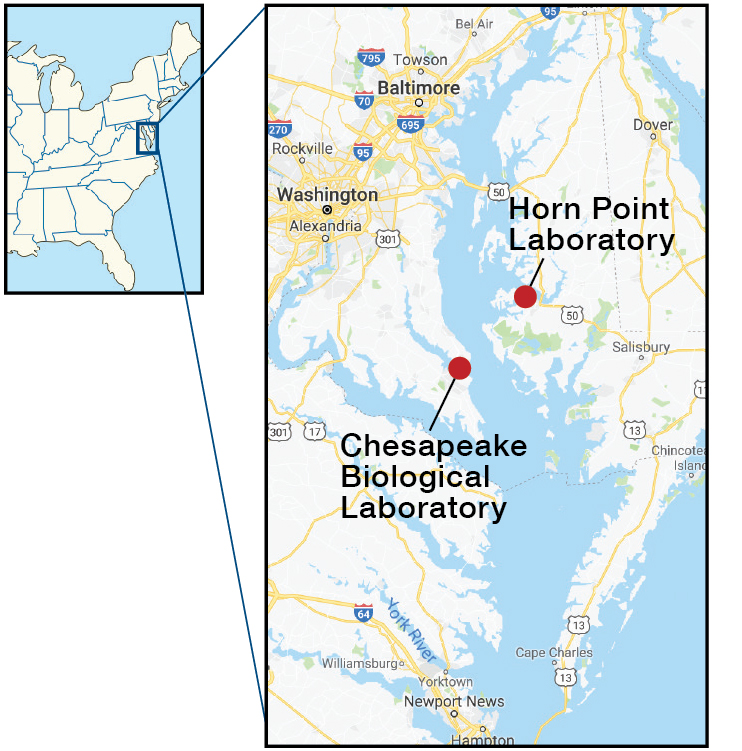
Interns will be placed at the University of Maryland Center for Environmental Science’s Chesapeake Biological Laboratory in Solomons, Maryland or Horn Point Laboratory in Cambridge, Maryland.
Research areas include: Benthic environment, climate change, contaminants, estuarine processes, and fisheries. Find more details below.
Professional Development Opportunities
- Training in lab safety and responsible conduct of research
- Scientific writing (abstracts, reviewing scientific literature, writing a technical paper)
- Science ethics
- Workshop on science communication and presentations
- Presenting your research at the end of the summer
Eligibility
We welcome community college students interested in coastal and marine science field experiences. Students that have completed their associate’s degree and are transitioning to a bachelor’s program are eligible. Preference is given to students local to the research laboratories.
How to Apply
Interested students are required to submit an application through the Maryland Sea Grant Application Portal. Submit the following:
- Application form with short answer questions
- After reviewing our Faculty Mentor Research Areas below, which project area would you like to work with and why? What prior training, coursework, or experiences will help you succeed in pursuing a summer research project? (300 words max)
- What are your career goals, and how will this summer program fit within your plan to achieve them? (300 words max)
- Is there anything else you would like the selection committee to know about you and your educational background? (300 words max)
- Resume
- Unofficial transcript(s)
- A professional contact that can give a recommendation
The deadline for best consideration is March 20. Applications submitted after this date may be reviewed if positions remain open.
Faculty Mentor Research Areas
- Ryan Woodland: Shallow coastal areas are recognized as critical habitat for estuarine fish and invertebrate communities. There will be opportunities for the intern to co-design a summer research project focused on shallow water fish or invertebrate communities. Interns will learn proper techniques in field methods, laboratory sample processing, statistical analysis, and scientific writing.
- Javier Lloret: The Lloret Lab offers a hands-on summer research experience exploring how coastal ecosystems respond to nutrients, pollution, and a changing climate. Our work focuses on estuaries and vegetated habitats, such as seagrass meadows, algal beds, and salt marshes, where plants, animals, and microbes interact to shape ecosystem health. The intern will gain experience working outdoors in the field, processing samples in the lab, analyzing data, and communicating scientific results. This program is ideal for students interested in marine science, environmental change, and learning how real-world research connects field observations to broader environmental challenges.
Maryland Sea Grant Welcomes All Community College Applicants
Sea Grant is committed to building research, extension, communication, and education programs that serve people with unique backgrounds, circumstances, needs, perspectives and ways of thinking. We encourage applicants of all ages, races, ethnicities, national origins, gender identities, sexual orientations, disabilities, cultures, religions, marital statuses, veteran status types, and income and socioeconomic status types to apply for this opportunity. Learn more about our mission in our strategic plan.
Contact Information
For more information about the program, please contact:
Michael Allen, Associate Director for Research and Administration
Chris Flight, Professional Development and Aquaculture Education Coordinator
Maryland Sea Grant College
5825 University Research Court, Suite 1350
University of Maryland
College Park, MD 20740
Phone: 301-405-7500
Email: reu@mdsg.umd.edu
Funding for this Summer Research Experience was provided by the Maxwell Hanrahan Foundation and the University of Maryland Center for Environmental Science.
Program Announcements
News and Blogs


Featured Fellow
Nina Santos
Nina Santos is a Ph.D. student at the Chesapeake Biological Laboratory at the University of Maryland Center for Environmental Science. For her dissertation, she is focused on small shrimp-like crustaceans called mysids – an understudied yet important part of many estuarine and coastal food webs.
Featured Research Project
Geochronology Study of Per- and Polyfluoroalkyl Substances Deposition and Ecosystem Response in the Chesapeake & Maryland Coastal Bays
Per- and polyfluoroalkyl substances (PFAS) are environmentally persistent contaminants linked to adverse health outcomes in humans and wildlife. In Maryland's Chesapeake Bay and Coastal Bays, PFAS accumulation in sediments and biota, as well as their ecological impacts, remain poorly understood. This project will reconstruct multidecadal PFAS deposition histories using sediment cores, apply microbial community profiling to assess benthic ecosystem responses, and translate findings into practical guidance for aquaculture and environmental management.