Knauss legislative fellowships in Congress help build careers — and they're fun and educational. See our video and fact sheet for details.
On the Bay
These Students Grow Professionally By Blogging About Science
Jeffrey Brainard •
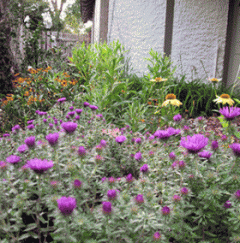
Graduate fellow William Yagatich learned through practice how to interview people effectively for his sociological research about efforts to restore the Chesapeake Bay. He also learned on the job an even more important task: being a new father to an infant girl.
Read more...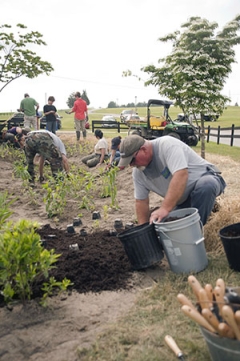
Stormwater Saviors: How These Volunteers Are Becoming Master Watershed Stewards
Daniel Pendick •
Meet the people accepted into the Cecil County Watershed Steward Academy. The extended training program equips Marylanders with the knowledge to launch projects that improve water quality in their own communities and the Chesapeake Bay beyond. Why do they want to become Master Watershed Stewards? And do they have what it takes to make it through the rigorous training?
Read more...
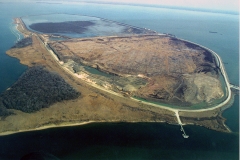
Photo Essay: An Island for Dredged Sediment Becomes a State Park for People
Jeffrey Brainard •
Hart-Miller Island has slowly risen in the Chesapeake Bay over the past 30 years. Now the state is expanding public access for hiking and biking there.
Read more...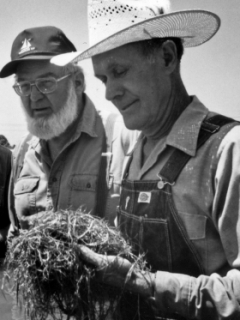
Bernie Fowler Honored for his "Cornpone Campaigns"
Michael W. Fincham •
In 1969, Bernie Fowler gave a short speech to the Parents and Teachers Association of Prince Frederick County. His message: he would be resigning as president of the PTA. Then he wrote a short letter to Governor Marvin Mandel. Read more...
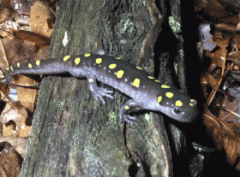
Teaching Science on TV: A Search for Salamanders
Adam Frederick •
When Maryland Sea Grant's education leader Adam Frederick appeared in a recent episode of the “Aqua Kids” TV show, he highlighted an unusual outdoor teaching tool — the yellow-spotted salamander. Changes in the abundance of this "indicator species" can signal declines in water quality.
Read more...Program Announcements
News and Blogs


ON THE BAY - BLOG ARCHIVE
ON THE BAY - BLOG TOPICS
Featured Fellow
Nina Santos
Nina Santos is a Ph.D. student at the Chesapeake Biological Laboratory at the University of Maryland Center for Environmental Science. For her dissertation, she is focused on small shrimp-like crustaceans called mysids – an understudied yet important part of many estuarine and coastal food webs.
Featured Research Project
Developing a habitat model for mysids, an important link in Chesapeake Bay food webs
Mysids are important mesozooplankton prey for many species of fish in Chesapeake Bay and are an important link in transferring energy from lower to upper trophic levels. Mysids also serve as biological vectors for benthic-pelagic coupling due to their diel vertical migration and omnivorous prey-switching behavior, which makes mysids important regulators of food web architecture. Despite their central role in coastal food webs, surprisingly little is known about mysid ecology and dynamics in Chesapeake Bay.