Knauss legislative fellowships in Congress help build careers — and they're fun and educational. See our video and fact sheet for details.
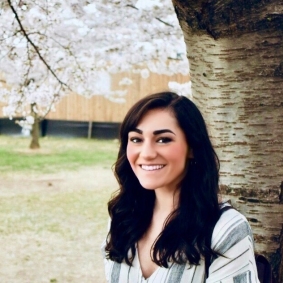
Katie Hornick
Fellowship Institution:
National Marine Fisheries ServiceStart Year:
2020Katie Hornick is working in the NOAA National Marine Fisheries Service’s Office of Habitat Conservation as a Habitat Restoration Specialist. She is working on a range of topics related to developing monitoring and evaluation approaches for Deepwater Horizon restoration.
Katie obtained her bachelor’s degree in natural science from Loyola Marymount University in Los Angeles, CA. After graduating from Loyola Marymount University, Katie spent a year and a half in Puerto Montt, Chile, studying the effect of salmon aquaculture on microbial diversity and community composition of sediments. She then went on to pursue a Ph.D. at the University of Maryland Center for Environmental Science’s Horn Point Laboratory in Cambridge, Maryland under the direction of Dr. Louis Plough. Her dissertation research examined, focusing on Harris Creek, the largest oyster sanctuary in the world. She used molecular tools to compare genetic diversity of restored and wild oysters and built a computer model that integrated oyster genetics and biology with real-world restoration scenarios.
In her spare time, Katie enjoys making jewelry, kayaking, hiking, and exploring new places with her pug, Oliver.
Main Menu (levels 2-3)
Program Announcements
-
-
Maryland Sea Grant has program development funds for start-up efforts, graduate student research, or strategic support for emerging areas of research. Apply here.
News and Blogs
Video Gallery
Sea Grant Film Explores a Diminishing Smithville
Smithville is a community on Maryland’s Eastern Shore, on the edge of the Blackwater National Wildlife Refuge. A century ago, Smithville had more than 100 residents. Today, it has four, in two homes: an elderly couple, and one elderly woman and her son, who cares for her.
Featured Fellow
Nina Santos
Featured Research Project
Geochronology Study of Per- and Polyfluoroalkyl Substances Deposition and Ecosystem Response in the Chesapeake & Maryland Coastal Bays
Per- and polyfluoroalkyl substances (PFAS) are environmentally persistent contaminants linked to adverse health outcomes in humans and wildlife. In Maryland's Chesapeake Bay and Coastal Bays, PFAS accumulation in sediments and biota, as well as their ecological impacts, remain poorly understood. This project will reconstruct multidecadal PFAS deposition histories using sediment cores, apply microbial community profiling to assess benthic ecosystem responses, and translate findings into practical guidance for aquaculture and environmental management.