Knauss legislative fellowships in Congress help build careers — and they're fun and educational. See our video and fact sheet for details.
Science Illustration and Its Role in Science Communication
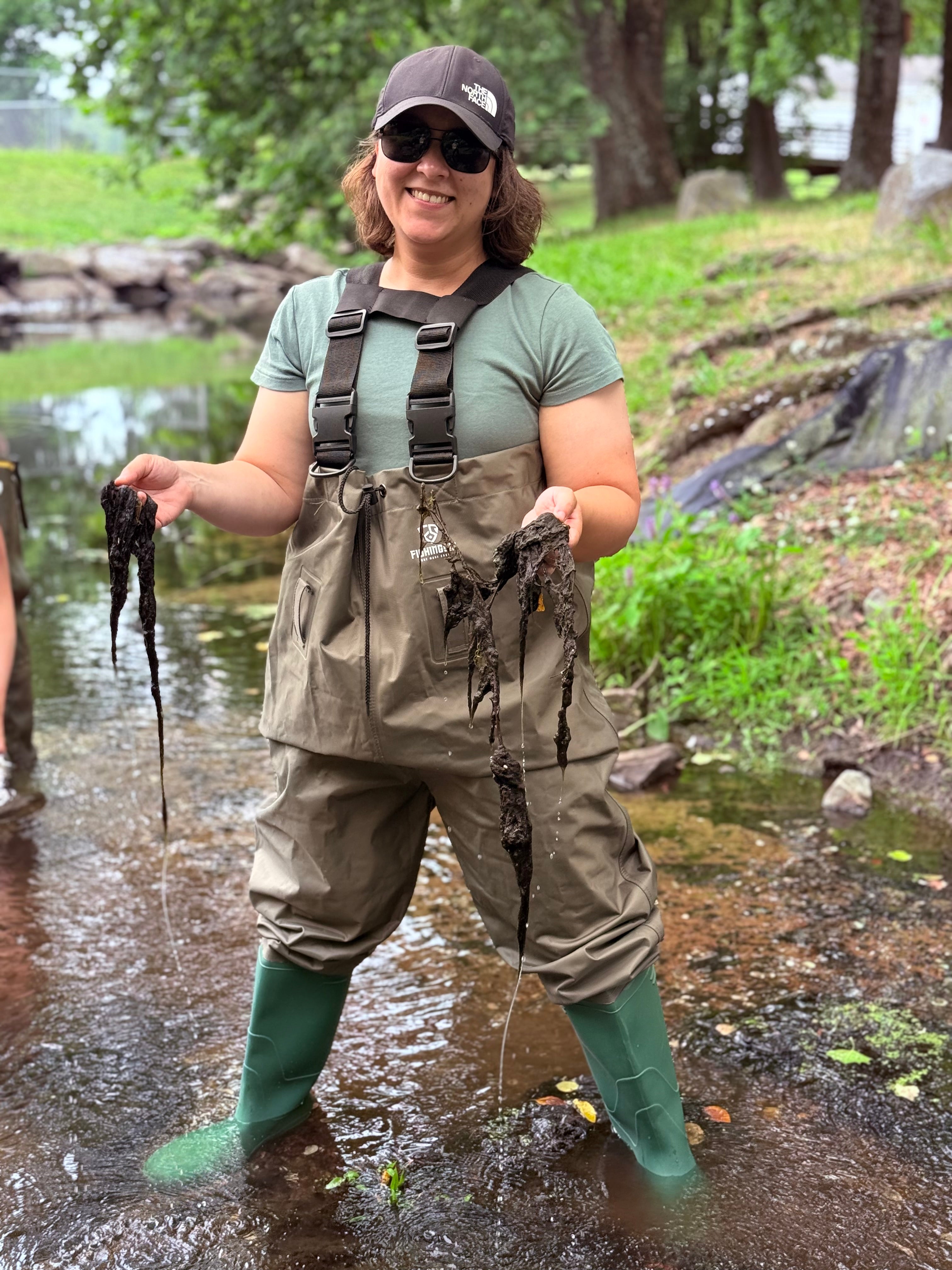
There I was, knee deep in a creek with snakes and fish weaving around my ankles in the 90-degree Maryland heat. I don’t think 18-year-old Julia drawing vases in her beginning art course could have ever imagined her career landing her here. However, my smile in the few photos taken that day says it all. I could not have been happier wading in the water to pick up potentially toxic algae with my bare hands. (Don’t worry, it’s only toxic if ingested!)
I have my upbringing to thank for how I got here. Born and raised in California, I was exposed to the state’s wonderful biodiversity. My interest in nature stems from taking trips to the coast to explore tidepools and growing up next to the Pacific Flyway, where I witnessed migratory birds fly through every year. Having never visited the east coast, this opportunity to take my scientific illustration skills across the country and immerse myself in a new environment has been a dream come true. I have enjoyed my time in Maryland exploring and learning about its ecosystems and biodiversity, and I will carry this education with me into future projects.
I earned my Bachelor of Fine Arts degree in illustration from California State University, Long Beach. And in 2025, I completed the Science Illustration Program at California State University, Monterey Bay. This program gave me an excellent footing as a science illustrator through coursework and first-hand experience working with researchers as an intern at the Monterey Bay Aquarium Research Institute.
At its core, science illustration uses visual media to communicate complex topics in compelling ways. Science illustration is necessary, even in today’s technologically advanced world. It can capture and portray subjects that simply cannot be shown with a photograph or accurately generated with a prompt, like ecological interactions that happen underwater in a specific time and space.
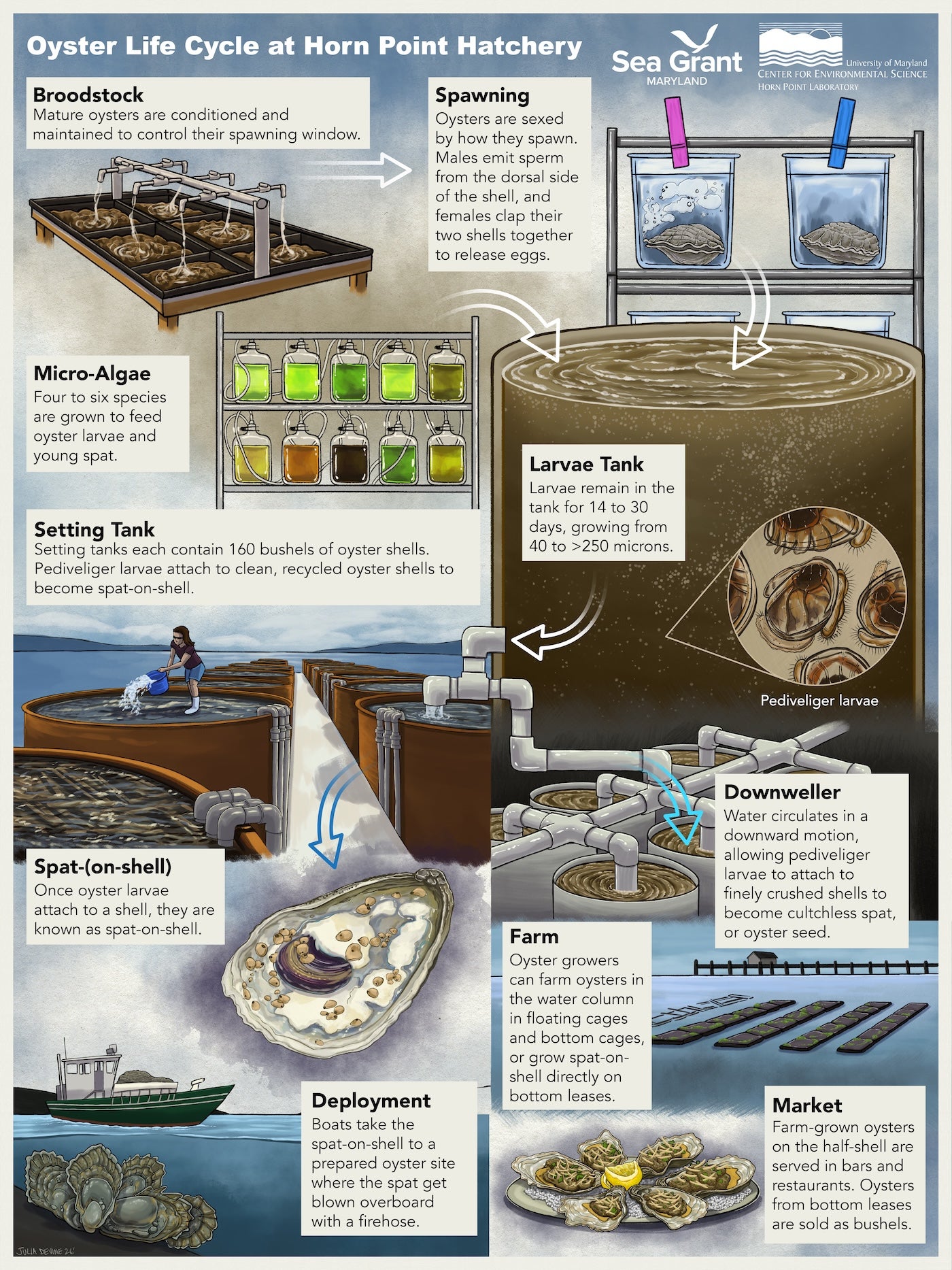
A scientist can see what needs to be understood and what is adding noise to the research. Through iterative feedback, an illustrator can remove the noise and use concepts such as color and callouts for clarity and emphasis. Research-based collaborative illustrations are made to convey the exact message of each project. Together, we create a visual story that can overcome language barriers and simplify what is confusing. I’ve always been inspired by the ways science illustration can bring what some might call “boring science” to life and create a story that both teaches and leaves an emotional impact.
Joining Maryland Sea Grant for the summer, I was presented with a huge variety of potential projects. I was able to complete five illustrations in a span of 11 weeks. The illustrations cover a wide range of topics relating to Maryland ecology, including a cyanobacteria outbreak, rain garden best practices, an oyster’s life cycle at an oyster hatchery, and the importance of wastewater treatment plants following a Potomac River sewage spill.
My most immersive project was with Cathy Wazniak from the Maryland Department of Natural Resources on illustrations highlighting a species of cyanobacteria that may be a threat to local waterways. Cyanobacteria, also called blue-green algae, are tiny, photosynthetic organisms found in water. Some cyanobacteria can accumulate in dense mats and produce neurotoxins that are harmful if ingested. I was fortunate enough to join Cathy on two trips into the field to see cyanobacteria up close. The first was the trip I mentioned earlier, where I trudged through a creek and saw clumps of cyanobacteria floating downstream. On a second trip, we took a boat onto the Susquehanna Flats. There, I swam among the submerged Bay grasses, combing my fingers through them as I looked for algae.
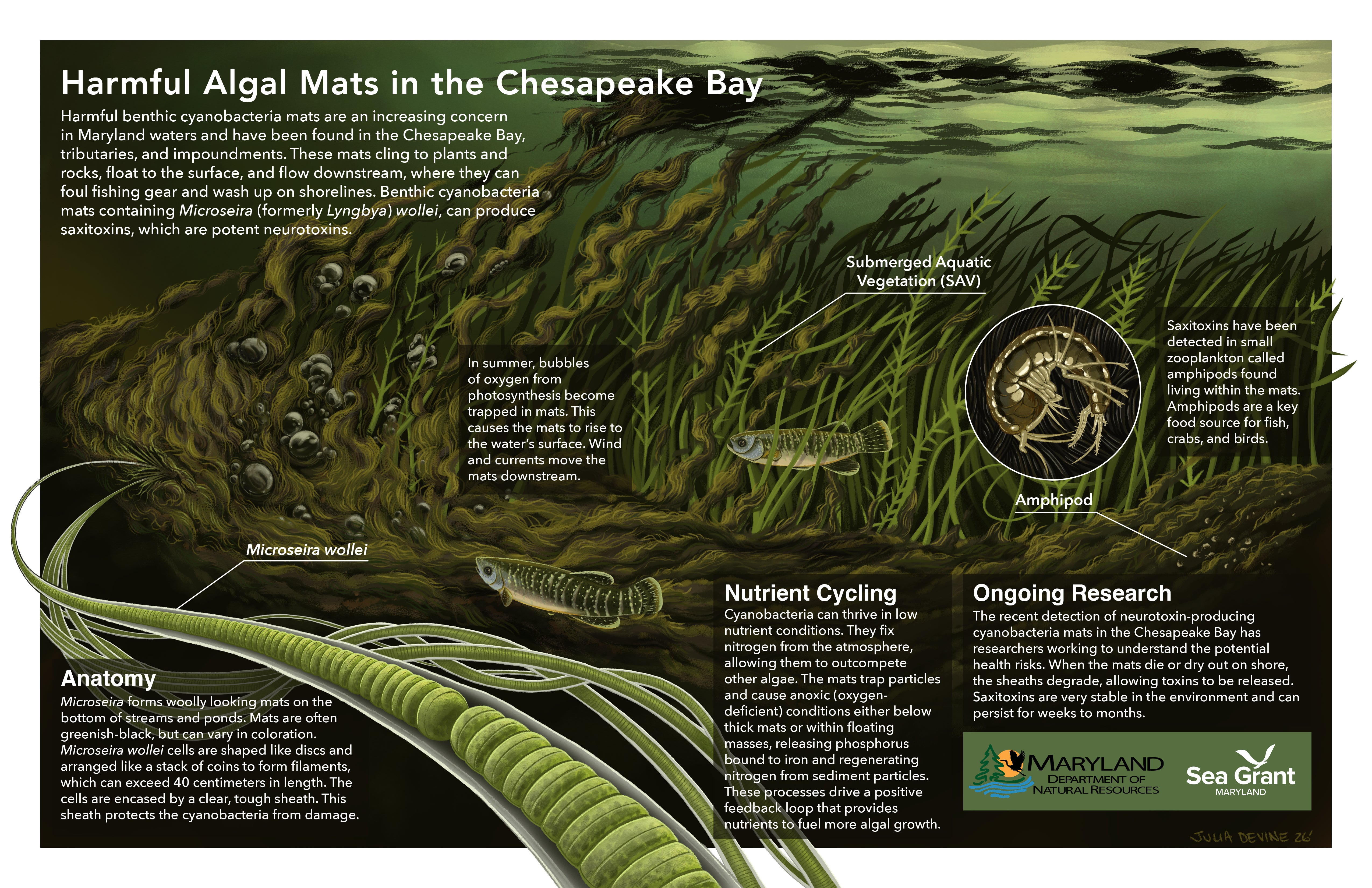
These types of field experiences are often overlooked or not available to science illustrators. But I believe they are critical to understanding a subject. Being able to take my own photos and physically feel the cyanobacteria with my hands helped me accurately render the algae in my illustrations.
The many projects I created during my two-month stay in Maryland, and the long list of projects I didn’t have the chance to work on, highlight the need for science illustration. It brings me hope of someday having an illustrator as a permanent position at a place like Maryland Sea Grant. There is something about a product created by human hands that inspires and sparks curiosity and also holds up the integrity of the science community. It is my goal to continue working directly with science organizations and researchers to bring complex topics to life and use art to break down communication barriers.
See all posts to the Fellowship Experiences blog