Knauss legislative fellowships in Congress help build careers — and they're fun and educational. See our video and fact sheet for details.
Baltimore City Teens Dive into Aquaculture, Science, and Sustainable Food Systems
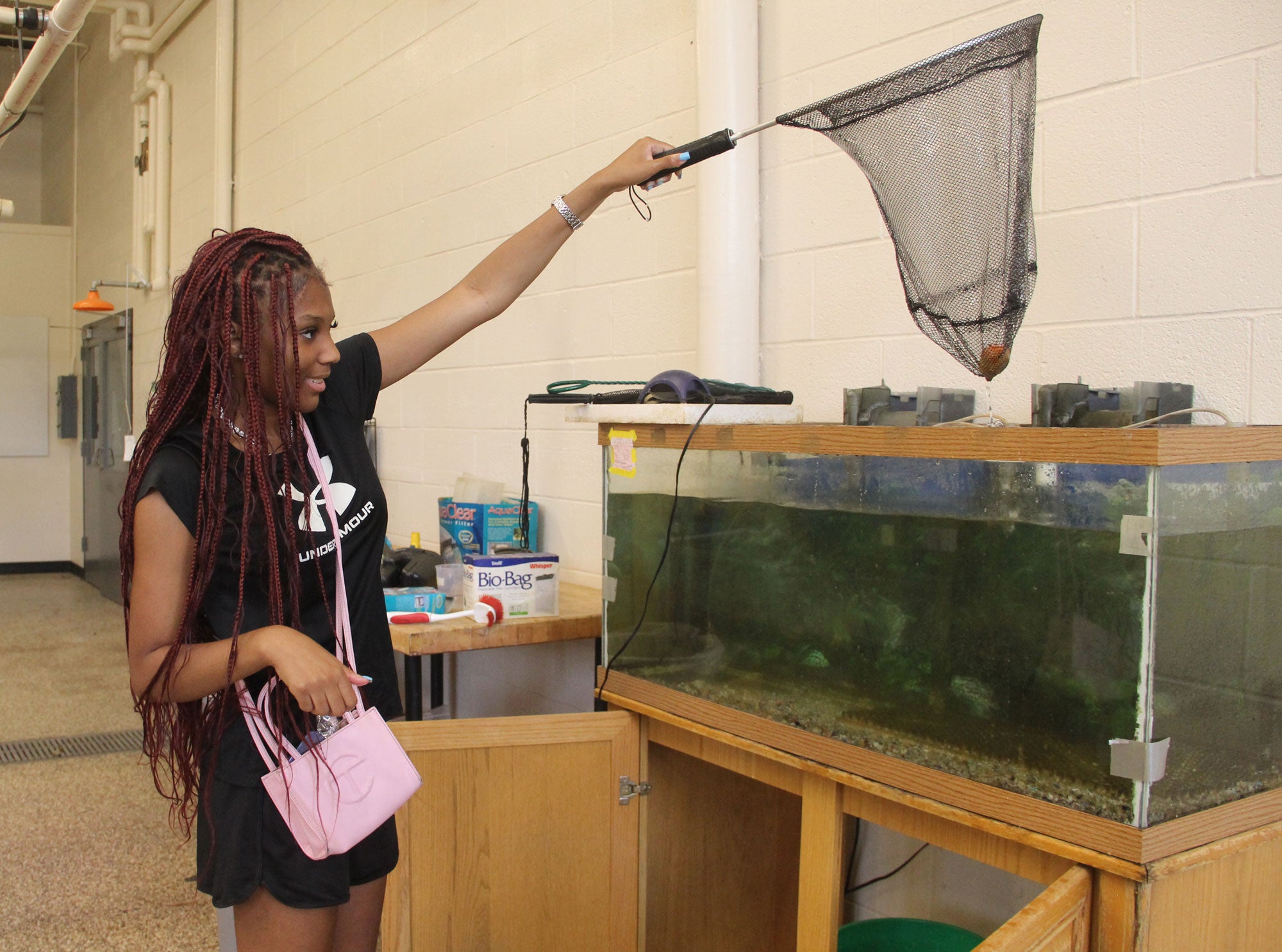
Khloe laughs nervously, holding a net at arm’s length as she lifts a flapping fish from the water. One by one, she carefully moves about a dozen goldfish from a small aquarium tank into a waiting bucket beside it. Her confidence grows with every splash.
Khloe, a junior at Western High School, is one of seven Baltimore City students who spent five weeks this summer dipping their toes (and hands) into the world of science and sustainability.
Made possible through a partnership between Maryland Sea Grant, Fishnet, and Baltimore City YouthWorks, the Career Lab: Sustainable Food Systems program introduces local teens to aquaculture, environmental science, and career paths through active, hands-on learning.
Aquaculture at Work
Unlike traditional YouthWorks placements where students remain with a single employer, the Career Lab program takes students across Maryland to experience applicable science in action. In Carroll County classrooms, students assembled recirculating aquaculture systems from the ground up. They cleaned tanks, transferred fish, monitored water quality, and calculated feed rates. As aquaculture grows as a fish production method across the US, these hands-on experiences can help students develop science skills and career paths.
“You’re learning, and then you’re also getting to test out the things that you learn,” says Khloe.
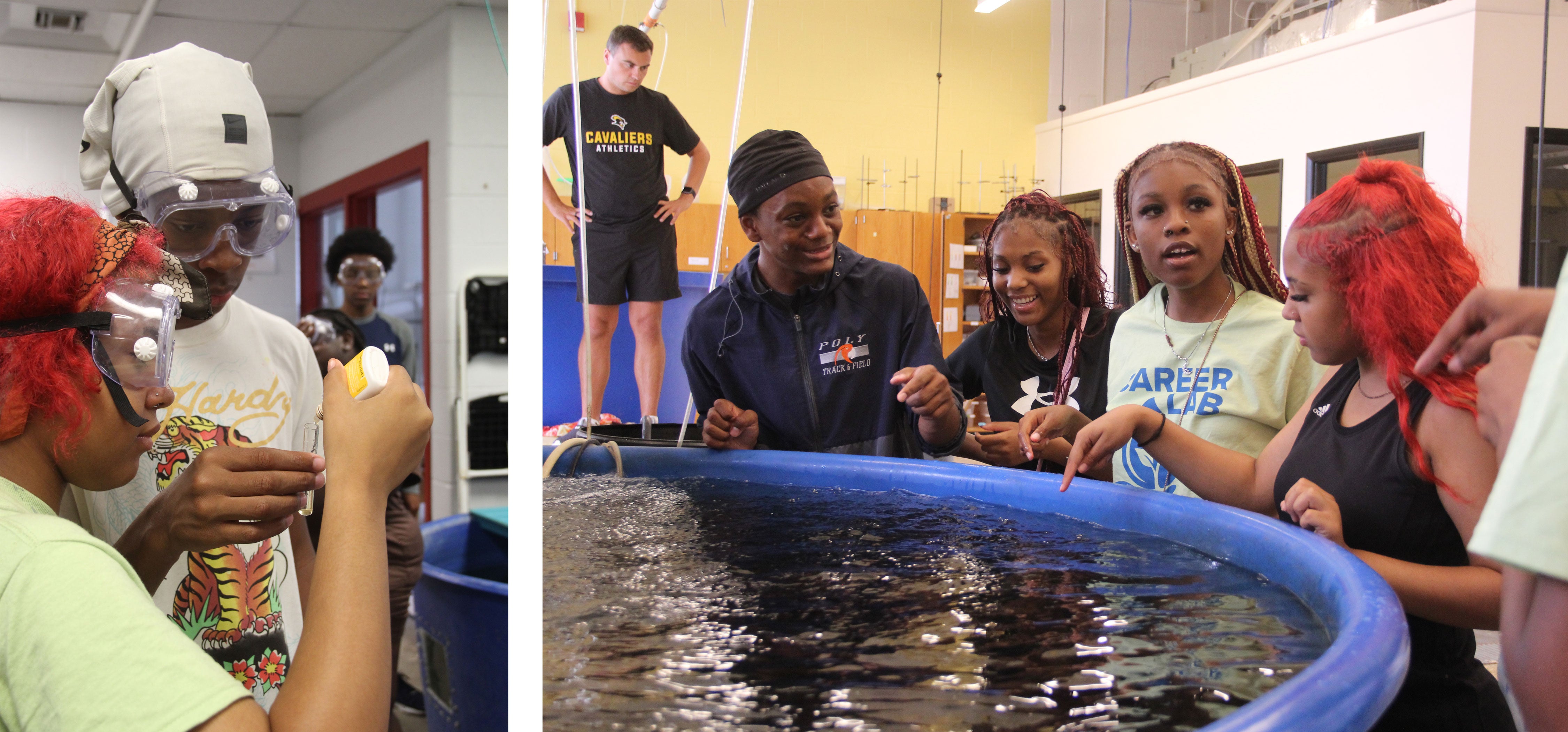
Diana, a freshman at Carver Vocational-Technical High School, agreed: “We ended up doing more activities than other jobs do, and we got to do more hands-on stuff.”
Setting Sail on the Chesapeake
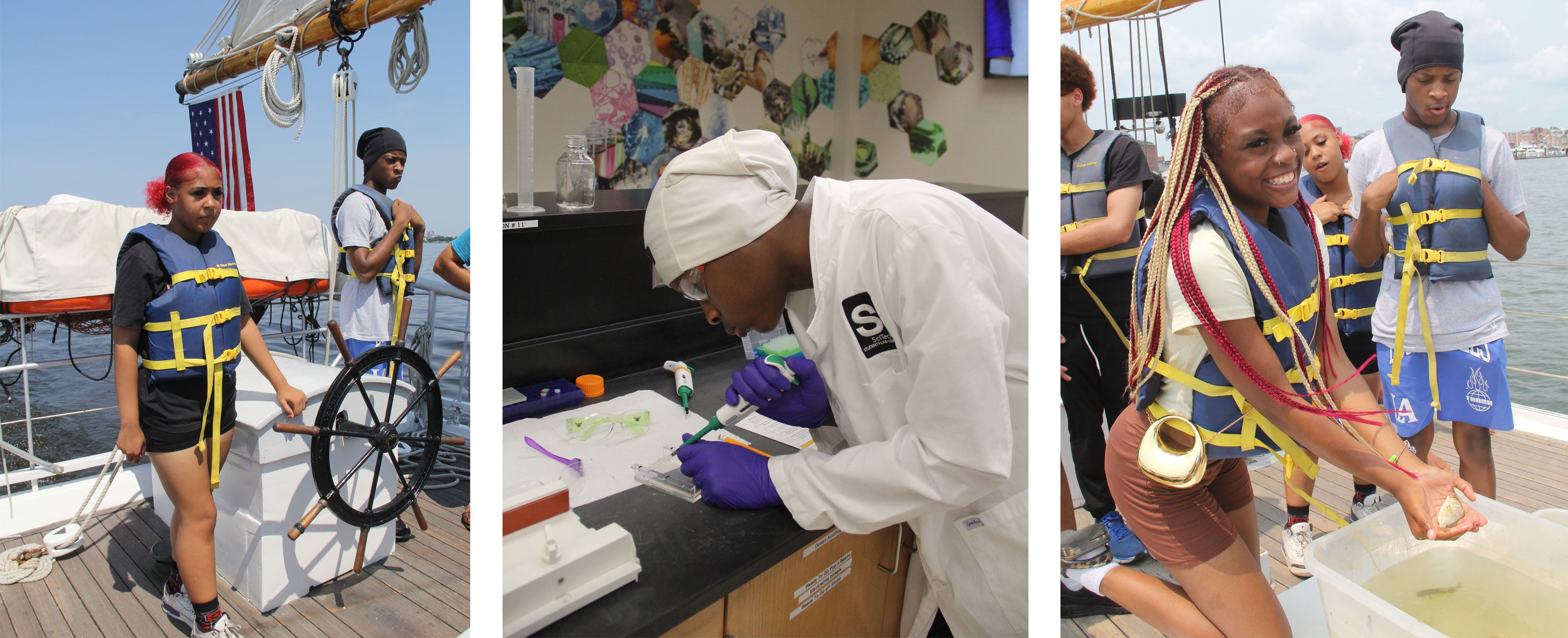
On a bright morning in June, the group set sail aboard the Sigsbee with the Living Classrooms Foundation. For several students, it was their first time on a boat. Together, they learned the mechanics of navigation, searched water samples for phytoplankton, and deployed a trawl net to catch fish, crabs, and jellyfish.
“Learning about the sailboat was kind of shocking to me,” says Tytianna, a senior at the ConneXions Charter School. “I didn’t know you had to do so much to really make a sailboat work.”
The group ventured into real research laboratories. They toured the Aquaculture Research Center at the Institute of Marine and Environmental Technology and conducted DNA electrophoresis experiments with Towson University’s SciTech Student Learning Lab. “It made me realize how important science is, and how many jobs there are that you can do, and how big of an impact it has,” says Diana.
Later in July, the students explored food production. They visited a local farm in Caroline County and took a cooking class at the Chesapeake Culinary Center, where they made fish tacos with locally sourced blue catfish. During an outing with the Coastal Conservation Association, they learned to bait a fishing hook, cast a line, fillet a fish, and steam blue crabs.
Connecting with Mentors
Technical skills were only part of the equation. Throughout the summer, guest speakers and industry professionals met with the group to share their career journeys. For Noah, the experience gave him new insight: “It showed me how many things you could be relating to environmental and marine science,” he says, noting a new interest in fields like environmental law.
Beyond career paths, the students practiced essential life skills, like working as a team. “When somebody didn’t understand something, we always could back each other up,” says Diana. Jashard, a recent graduate of Mergenthaler Vocational-Technical High School (MerVo-Tech), emphasized how much they relied on each other for problem-solving.
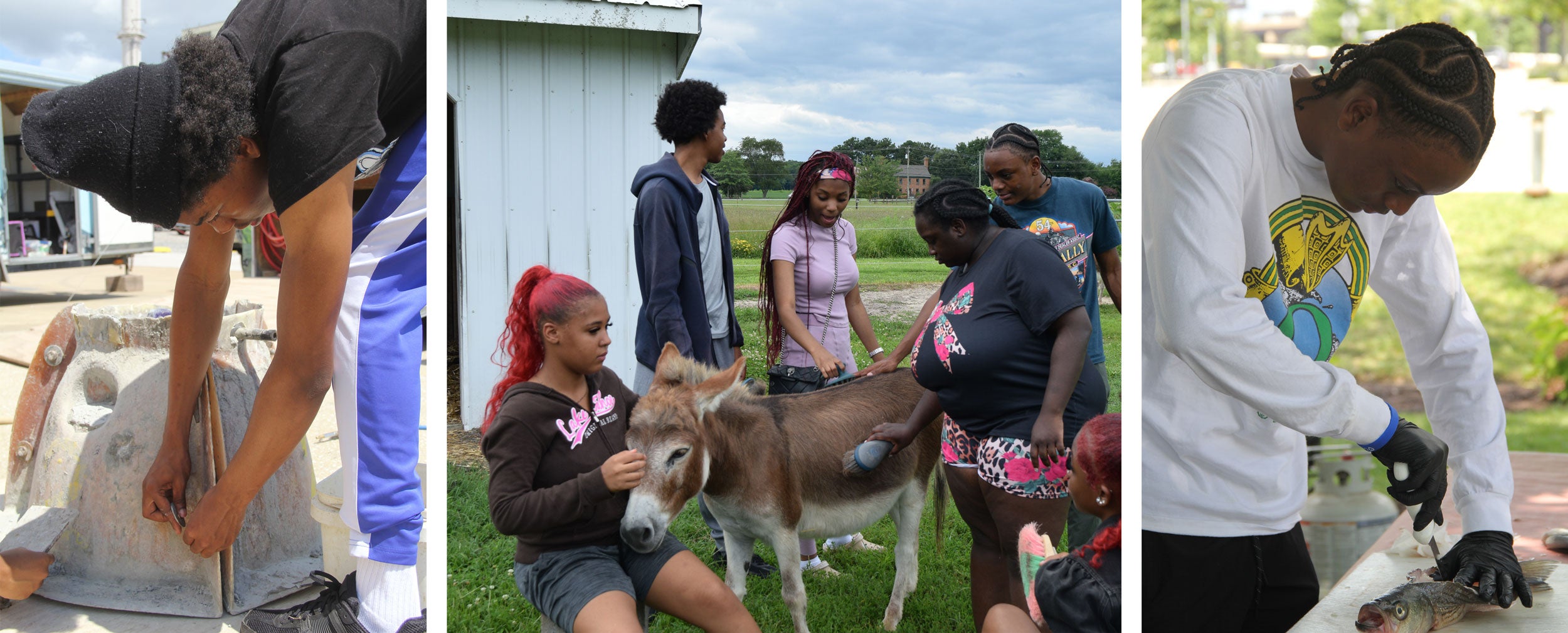
Some students gained self-assurance. “It helped me with my confidence and to start talking more and be more outgoing,” says Antonio, a MerVo-Tech freshman.
These opportunities would not have been possible without the dedicated individuals who drive the Career Lab program behind the scenes. Adam Frederick, Maryland Sea Grant’s assistant director for education, brings together diverse partners to build the immersive programming students take part in. “We’re learning more and more about the value of the program through the partners that are working with us and how the students engage with those partners,” says Frederick.
Fishnet owner Keyia Yalcin serves as the students’ main mentor, guiding them through the daily demands of the program while remaining someone they can turn to for support. Her mentorship left a lasting impression on the group. “She pushed us to work harder so we won’t just be slouchy and be active and productive,” says Jashard.
As the 2026 Career Lab cohort moved through the program, they came up against some unfamiliar topics and experiences. In meeting these challenges, the students not only grew their knowledge of marine science and sustainable food systems but also saw their own potential in a new light. "Once you talk to somebody and get that confidence," says Tytianna, "it’s like, OK, now I believe I can do it."
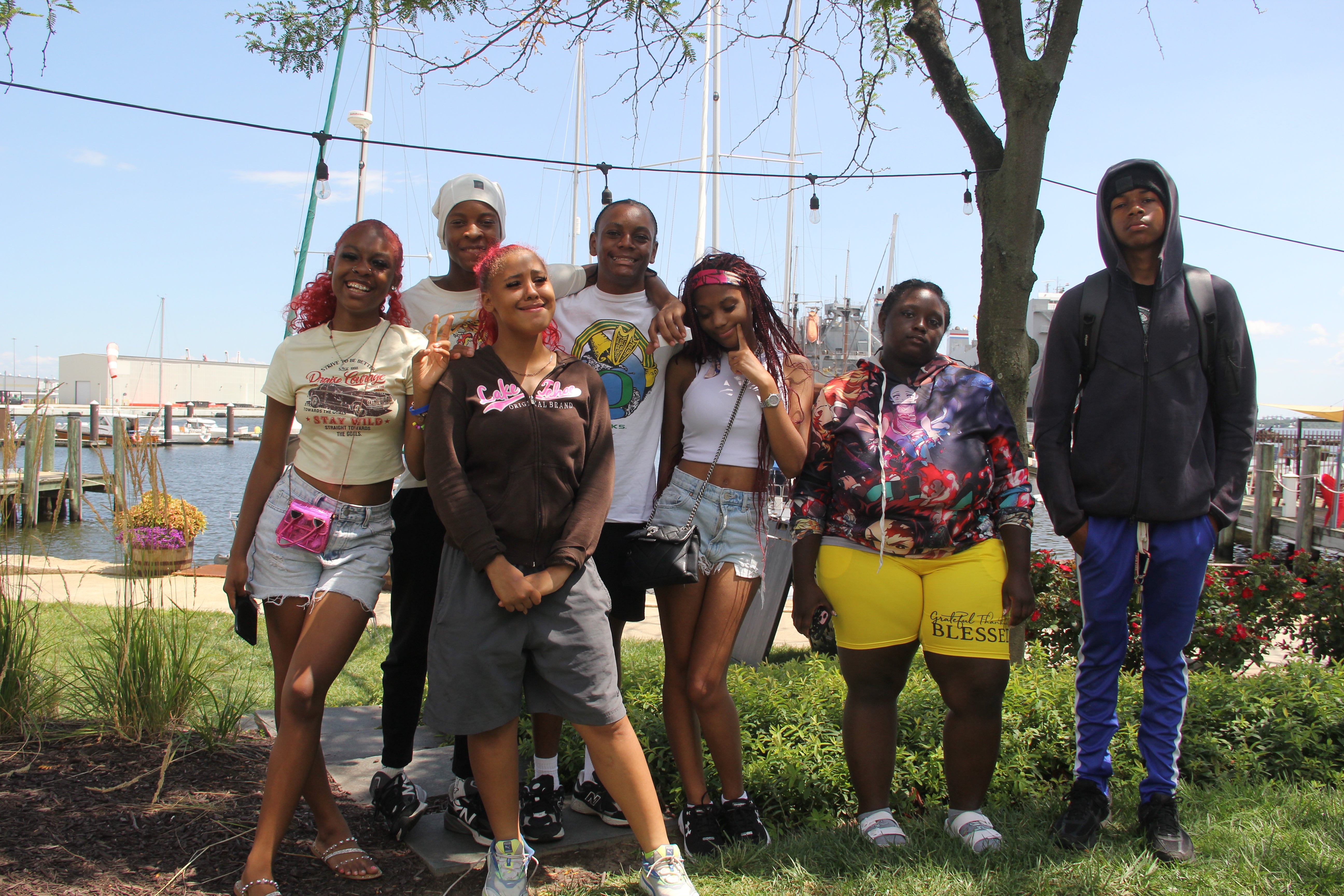
Career Lab: Sustainable Food Systems gives Baltimore City youth the tools, mentorship, and confidence to explore careers in science, aquaculture, and sustainable food. Help us power next summer’s Career Lab with a donation today! mdsg.umd.edu/education/career-lab-summer-program
See all posts from the On the Bay blog
Program Announcements
News and Blogs


ON THE BAY - BLOG ARCHIVE
ON THE BAY - BLOG TOPICS
Featured Fellow
Nina Santos
Nina Santos is a Ph.D. student at the Chesapeake Biological Laboratory at the University of Maryland Center for Environmental Science. For her dissertation, she is focused on small shrimp-like crustaceans called mysids – an understudied yet important part of many estuarine and coastal food webs.
Featured Research Project
Geochronology Study of Per- and Polyfluoroalkyl Substances Deposition and Ecosystem Response in the Chesapeake & Maryland Coastal Bays
Per- and polyfluoroalkyl substances (PFAS) are environmentally persistent contaminants linked to adverse health outcomes in humans and wildlife. In Maryland's Chesapeake Bay and Coastal Bays, PFAS accumulation in sediments and biota, as well as their ecological impacts, remain poorly understood. This project will reconstruct multidecadal PFAS deposition histories using sediment cores, apply microbial community profiling to assess benthic ecosystem responses, and translate findings into practical guidance for aquaculture and environmental management.