Knauss legislative fellowships in Congress help build careers — and they're fun and educational. See our video and fact sheet for details.
Maureen Brooks
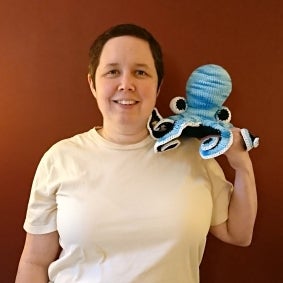
Maureen Brooks joined the Oceanographer of the Navy as the Interagency & International Policy Liaison. She will be working on naval oceanography policy, including issues related to oceanography, marine weather, navigation, and precise time.
Interactions between ocean physics and seaweed biology are the focus of Brooks’ Ph.D. work in the Marine Estuarine Environmental Sciences Graduate Program at the University of Maryland Center for Environmental Science. She used computer models and satellite observations to understand how Sargassum seaweed moves and grows throughout the Atlantic. Her research helps explain why so much of it has been washing up on beaches in recent years and may improve predictions that local residents depend on to prepare for these wash-up events.
As an undergraduate at McDaniel College and a master’s student at the University of Maryland, she combined her loves of science and math into computer models to understand the effects of nutrient pollution in Chesapeake Bay. Brooks was also a Blue Waters Fellow with the National Center for Supercomputing Applications, where she used high performance computing to conduct environmental research. In her free time, she enjoys kayaking, creative writing, and crafting sea creatures out of yarn.
Main Menu (levels 2-3)
Program Announcements
-
-
Maryland Sea Grant has program development funds for start-up efforts, graduate student research, or strategic support for emerging areas of research. Apply here.
News and Blogs
Video Gallery
Sea Grant Film Explores a Diminishing Smithville
Smithville is a community on Maryland’s Eastern Shore, on the edge of the Blackwater National Wildlife Refuge. A century ago, Smithville had more than 100 residents. Today, it has four, in two homes: an elderly couple, and one elderly woman and her son, who cares for her.
Featured Fellow
Nina Santos
Featured Research Project
Geochronology Study of Per- and Polyfluoroalkyl Substances Deposition and Ecosystem Response in the Chesapeake & Maryland Coastal Bays
Per- and polyfluoroalkyl substances (PFAS) are environmentally persistent contaminants linked to adverse health outcomes in humans and wildlife. In Maryland's Chesapeake Bay and Coastal Bays, PFAS accumulation in sediments and biota, as well as their ecological impacts, remain poorly understood. This project will reconstruct multidecadal PFAS deposition histories using sediment cores, apply microbial community profiling to assess benthic ecosystem responses, and translate findings into practical guidance for aquaculture and environmental management.