Knauss legislative fellowships in Congress help build careers — and they're fun and educational. See our video and fact sheet for details.
Carrie Soltanoff
Fellowship Institution:
NOAA National Marine Fisheries ServiceStart Year:
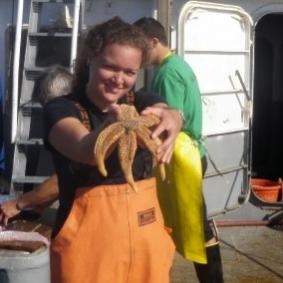
2013Carrie Soltanoff served in the National Marine Fisheries Service Office of International Affairs at NOAA. Her portfolio included shark and Atlantic tuna conservation, bycatch reduction, and regulation of foreign fishing vessels. She produced briefing materials and policy papers for meetings and negotiations on international issues.
Originally from upstate New York, Soltanoff completed a master of science in the Sustainable Development and Conservation Biology program at the University of Maryland. During her graduate studies, Soltanoff carried out applied research projects for the World Wildlife Fund, Woods Hole Oceanographic Institution, and Rare Conservation.
She served as a Peace Corps volunteer for two years in Ecuador, where she conducted work for her thesis about shifting environmental baselines among fishermen -- the idea that each generation of fishermen has a distinct view of the current state of fish populations -- and the implications for management of a marine reserve. Soltanoff used her fluency in Spanish to interview the fishermen about their work for her research.
Following her fellowship, Soltanoff was hired as consultant for the National Marine Fisheries Service Highly Migratory Fisheries Management Division through a contract with I.M. Systems Group.
Main Menu (levels 2-3)
Program Announcements
-
-
Maryland Sea Grant has program development funds for start-up efforts, graduate student research, or strategic support for emerging areas of research. Apply here.
News and Blogs
Video Gallery
Sea Grant Film Explores a Diminishing Smithville
Smithville is a community on Maryland’s Eastern Shore, on the edge of the Blackwater National Wildlife Refuge. A century ago, Smithville had more than 100 residents. Today, it has four, in two homes: an elderly couple, and one elderly woman and her son, who cares for her.
Featured Fellow
Nina Santos
Featured Research Project
Developing a habitat model for mysids, an important link in Chesapeake Bay food webs
Mysids are important mesozooplankton prey for many species of fish in Chesapeake Bay and are an important link in transferring energy from lower to upper trophic levels. Mysids also serve as biological vectors for benthic-pelagic coupling due to their diel vertical migration and omnivorous prey-switching behavior, which makes mysids important regulators of food web architecture. Despite their central role in coastal food webs, surprisingly little is known about mysid ecology and dynamics in Chesapeake Bay.