Knauss legislative fellowships in Congress help build careers — and they're fun and educational. See our video and fact sheet for details.
Rebecca Peters
Fellowship Institution:
NOAA, National Marine Fisheries Service, Office of Science and TechnologyStart Year:
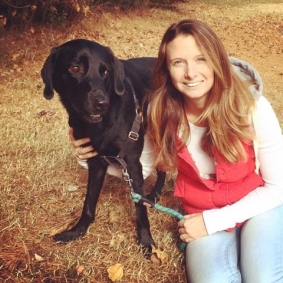
2017Rebecca Peters is working in the NOAA National Marine Fisheries Service’s Office of Science and Technology as the fisheries habitat and ecosystem science coordinator. Her focus includes expanding the habitat science program and learning how habitat science is incorporated into stock assessments and ecosystem based fisheries management. She will also assist in coordinating Ecosystem Sciences and Management Working Group meetings.
Originally from Pennsylvania, Peters completed her M.S. degree in the Marine Estuarine Environmental Sciences Graduate Program at the University of Maryland Eastern Shore. Her thesis work focused on juvenile black sea bass in the Maryland Coastal Bays, an estuary where they had never been studied before. She analyzed trawl survey data to determine long-term spatial and temporal trends in abundance and conducted a field study using mark-recapture to delineate essential fish habitat for juvenile black sea bass.
Peters conducted research in the Florida Keys and South Water Caye, Belize. She also interned with the National Marine Fisheries Service’s Shark Population Assessment Group in Panama City, Florida, and was a marine science instructor at Newfound Harbor Marine Institute in Big Pine Key, Florida. In her free time she enjoys the outdoors by hiking, diving, and exploring new places with her dog, Willy.
Main Menu (levels 2-3)
Program Announcements
-
-
Maryland Sea Grant has program development funds for start-up efforts, graduate student research, or strategic support for emerging areas of research. Apply here.
News and Blogs
Video Gallery
Sea Grant Film Explores a Diminishing Smithville
Smithville is a community on Maryland’s Eastern Shore, on the edge of the Blackwater National Wildlife Refuge. A century ago, Smithville had more than 100 residents. Today, it has four, in two homes: an elderly couple, and one elderly woman and her son, who cares for her.
Featured Fellow
Nina Santos
Featured Research Project
Developing a habitat model for mysids, an important link in Chesapeake Bay food webs
Mysids are important mesozooplankton prey for many species of fish in Chesapeake Bay and are an important link in transferring energy from lower to upper trophic levels. Mysids also serve as biological vectors for benthic-pelagic coupling due to their diel vertical migration and omnivorous prey-switching behavior, which makes mysids important regulators of food web architecture. Despite their central role in coastal food webs, surprisingly little is known about mysid ecology and dynamics in Chesapeake Bay.