Knauss legislative fellowships in Congress help build careers — and they're fun and educational. See our video and fact sheet for details.
Crabs, Oysters, Other Animals
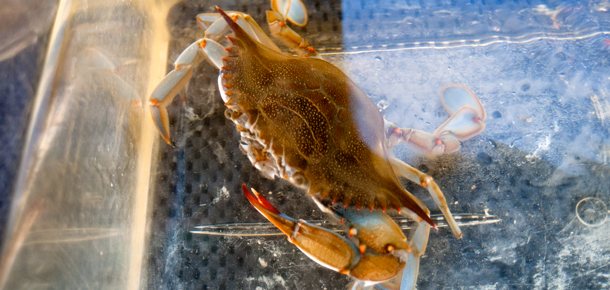
Nothing embodies the Chesapeake Bay like the sight of a blue crab hanging off a fishing line or a plate of grilled oysters. These two animals have provided a way of life for Bay watermen for centuries and hold a central place in the culture and history of Maryland.
Both crabs and oysters, however, face an uncertain future on the Chesapeake. Blue crab populations have risen and plummeted several times during the history of the fishery. And because of past overfishing and disease, Bay oyster numbers now sit at a fraction of their historic volume.
Maryland Sea Grant recognizes that conserving the Bay’s crabs and oysters, and the livelihood of Bay watermen, is important to the future of the state. To that end, we conduct science and outreach related to these iconic animals to ensure sustainable and profitable fisheries.
Maryland Sea Grant Extension supports the work of Extension agents and specialists who provide a variety of technical assistance to support Maryland's developing oyster aquaculture industry and the restoration of wild oysters in the Bay, working in partnership with other Bay organizations. Our Extension staff members have worked to develop legislation to support this industry, to operate one of the largest oyster hatcheries, and to help dozens of Marylanders find funding and technical support to begin a career in oyster growing.
Oysters and crabs may be the Chesapeake Bay’s most famous fauna. but the estuary is also home to a colorful diversity of animal life — including spawning fish, crawling turtles, and even stinging jellyfish.
Like their more famous neighbors in the Chesapeake Bay ecosystem, these eclectic animals are crucial to its functioning. Each species plays a specific, and often complicated, role in the estuary.
Related Products
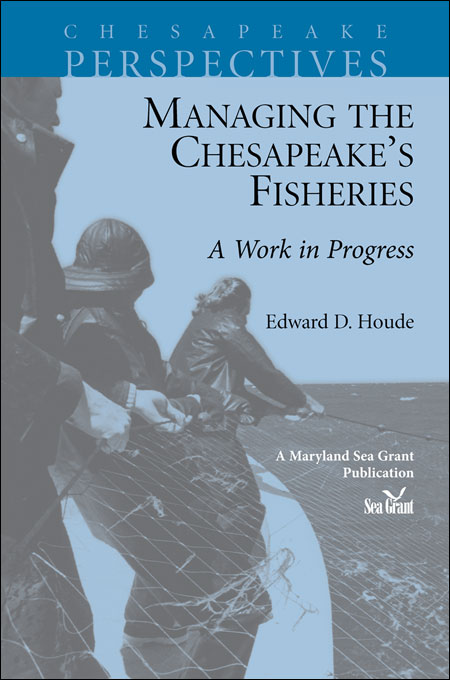
Managing the Chesapeake's Fisheries: A Work in Progress
Houde, Edward D
This monograph is a major assessment of the state of key species in the Chesapeake Bay — the eastern oyster, blue crab, striped bass, and Atlantic menhaden — and of the prospects for shifting from single-species fisheries management to…
$12.95
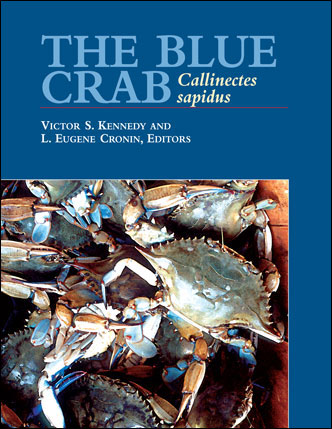
The Blue Crab: Callinectes Sapidus (Sale Price: $25)
Kennedy, Victor S. and L. Eugene Cronin, editors
An essential resource for researchers, students, and managers, this book is the first comprehensive reference work on the blue crab, Callinectes sapidus.
The blue crab is a significant U.S. commercial and recreational species from…
$25.00
Program Announcements
News and Blogs


Featured Fellow
Nina Santos
Nina Santos is a Ph.D. student at the Chesapeake Biological Laboratory at the University of Maryland Center for Environmental Science. For her dissertation, she is focused on small shrimp-like crustaceans called mysids – an understudied yet important part of many estuarine and coastal food webs.
Featured Research Project
Geochronology Study of Per- and Polyfluoroalkyl Substances Deposition and Ecosystem Response in the Chesapeake & Maryland Coastal Bays
Per- and polyfluoroalkyl substances (PFAS) are environmentally persistent contaminants linked to adverse health outcomes in humans and wildlife. In Maryland's Chesapeake Bay and Coastal Bays, PFAS accumulation in sediments and biota, as well as their ecological impacts, remain poorly understood. This project will reconstruct multidecadal PFAS deposition histories using sediment cores, apply microbial community profiling to assess benthic ecosystem responses, and translate findings into practical guidance for aquaculture and environmental management.