Knauss legislative fellowships in Congress help build careers — and they're fun and educational. See our video and fact sheet for details.
Jellyfish
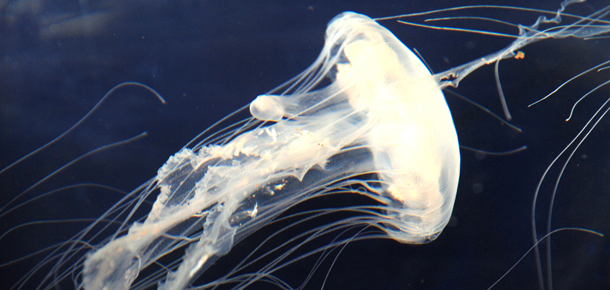
When most Marylanders think of jellyfish, they picture Bay beaches surrounded by globes of milky-white — and stinging — sea nettles. But despite this dubious status, jellyfish and their relatives play an integral role in the Chesapeake ecosystem. Many of these animals, closely related to corals and anemones, are important grazers in the Bay. They keep some of the estuary’s smaller animals from growing wild.
Here are some of the jellyfish, or jellyfish relatives, that frequent the Chesapeake Bay.
- Sea nettles: These true jellyfish thrive around the Chesapeake, usually during summers, because of the estuary’s low salt content. Sea nettle tentacles, which carry their infamous stings, can grow up to five or six feet long.
While nettles are mostly known for the pain they deal to swimmers, these animals are also important consumers of comb jellies. Comb jellies eat fish and oyster larvae in the Bay, making sea nettles a natural ally of many of the Bay’s fish species. Not to mention the region’s watermen.
To learn more about the ecological role of sea nettles in the Chesapeake, read "Jellyfish: Studying Summer's Unwelcome Visitors" in Maryland Marine Notes newsletter.
- Lion’s mane: These jellyfish, which also carry a powerful sting, can be found in the Chesapeake during the wintertime, earning them the name “winter jellies.” They gained fame after Sir Arthur Conan Doyle included them in his Sherlock Holmes mystery story “The Adventure of the Lion’s Mane.”
- Moon jelly: These jellyfish appear in the Bay during the summer. They resemble a flattened disk. Their bell can grow to about 10 to 12 inches wide, although they’re tentacles are thin and short. While they’re effective at stinging small prey, such as mollusks and plankton, their sting isn’t harmful to people.
- Comb jelly: Despite their name, comb jellies, or ctenophores, aren’t jellyfish at all. Instead, they belong to a distantly related group of animals known for their bristly rows of hair-like cilia, called ctenes. Two ctenophore species can be found in the Chesapeake Bay, the sea walnut, Mnemiopsis leidyi, and the pink comb jelly, Beroe ovata. Comb jellies do not sting and are nearly transparent. Most people rarely notice them except at night, when they glow (or bioluminesce) if disturbed. They are, however, voracious filter feeders, consuming large quantities of fish and oyster larvae.
Photograph by Jarek Tuszynski, National Zoo, Washington DC
Program Announcements
News and Blogs


Featured Fellow
Nina Santos
Nina Santos is a Ph.D. student at the Chesapeake Biological Laboratory at the University of Maryland Center for Environmental Science. For her dissertation, she is focused on small shrimp-like crustaceans called mysids – an understudied yet important part of many estuarine and coastal food webs.
Featured Research Project
Geochronology Study of Per- and Polyfluoroalkyl Substances Deposition and Ecosystem Response in the Chesapeake & Maryland Coastal Bays
Per- and polyfluoroalkyl substances (PFAS) are environmentally persistent contaminants linked to adverse health outcomes in humans and wildlife. In Maryland's Chesapeake Bay and Coastal Bays, PFAS accumulation in sediments and biota, as well as their ecological impacts, remain poorly understood. This project will reconstruct multidecadal PFAS deposition histories using sediment cores, apply microbial community profiling to assess benthic ecosystem responses, and translate findings into practical guidance for aquaculture and environmental management.